
How Amigurumi Is Made — The Step-by-Step Craft Behind Every Made of Hands Plushie
By Made of Hands | Handmade Crochet & Knit Gifts from Uttarakhand

Most people hold a Made of Hands plushie for the first time and say some version of the same thing: how did someone make this?
It’s a reasonable question. A finished amigurumi — whether it’s a round little frog, a plump penguin, or a cat in a loaf position — looks deceptively simple. Smooth. Compact. Almost like it was designed by a machine.
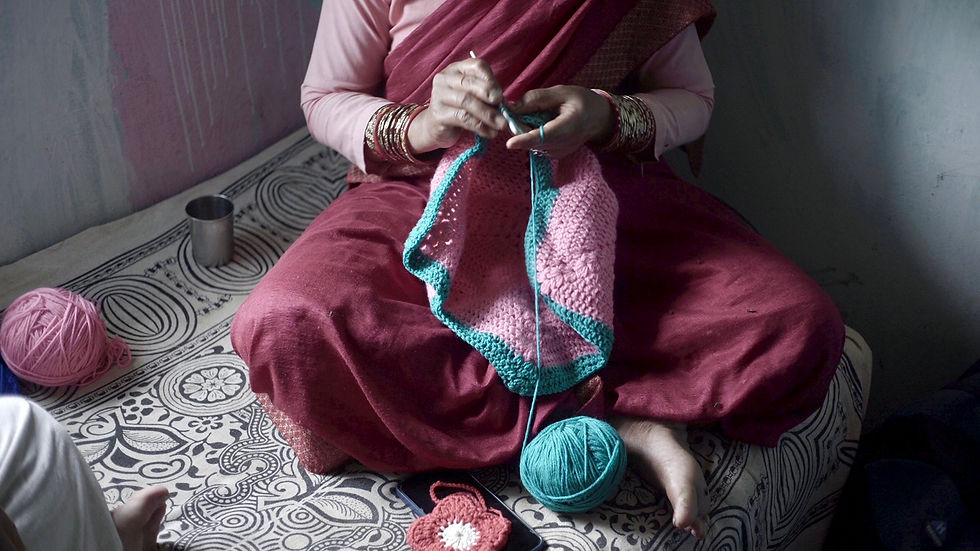
It wasn’t. Every single one is made entirely by hand, by a woman artisan in the Himalayan foothills of Almora, Uttarakhand, using a crochet hook and yarn and a pattern she knows by feel as much as by instruction. The process takes hours. The result is something that cannot be replicated exactly — not by a factory, and not by the same artisan twice.
Here is what actually goes into making one.
What Is Amigurumi and Why Is It Always Crocheted?
Before the steps, a quick answer to a question that comes up often: why is amigurumi always crocheted, never knitted?
The answer is structural. Crochet builds fabric one loop at a time using a single hook — which means the crocheter has complete control over shaping at every stitch. This makes it possible to increase and decrease stitches in precise places, building a three-dimensional form — a sphere, a cone, an irregular curve — from the inside out. Knitting, which works with two needles and multiple live stitches simultaneously, is better suited to flat fabrics that drape and stretch. It is not well suited to the compact, sculptural, stuffable forms that amigurumi requires.
Every Made of Hands plushie — the Hoppy Toes frog, the Purrfect Pal cat, the Puddle duck, the Totto tortoise — begins with crochet because crochet is the only technique that makes that particular kind of shape possible.
Step 1 — Choosing the Yarn and Hook
Every amigurumi begins with yarn selection. The yarn we use at Made of Hands is high-quality acrylic — soft, non-itchy, child-safe, and consistent enough in weight and twist to produce reliable results across every piece. The consistency of the yarn matters more for amigurumi than for almost any other crochet application, because a variation in yarn weight or twist changes how tightly the stitches close — which in turn affects whether the stuffing shows through, how the shape holds, and how the finished piece feels in the hand.

The hook size is chosen to match the yarn weight — and deliberately set slightly smaller than the yarn’s standard recommendation. This is a technique specific to amigurumi: a tighter tension means smaller gaps between stitches, which means the stuffing stays inside the piece rather than showing through.
This is not something that can be taught in a single instruction. It is something that becomes instinctive with practice — the kind of practical knowledge that our artisans in Almora carry in their hands after years of making.
Step 2 — Starting the Magic Ring
Every amigurumi piece begins from the centre of its base shape, worked outward in continuous rounds. The starting point is a technique called the magic ring — a loop formed around the fingers that can be tightened into a closed centre once the first round of stitches is worked into it.

The alternative — a chain ring — leaves a visible hole at the centre. The magic ring closes that hole completely, giving the base of an amigurumi the smooth, seamless appearance that distinguishes a well-made piece from a rough one. It is a small technical detail that makes a large visual difference.
Step 3 — Building the Shape Round by Round
This is the longest and most demanding part of making an amigurumi — and the part that requires the most skill.
Each round builds on the previous one, adding or removing stitches (increasing or decreasing) in specific positions to create the three-dimensional form. A sphere — the base shape of most amigurumi bodies and heads — is built by increasing stitches steadily to the widest point and then decreasing symmetrically back down. The rate of increase and decrease determines whether the sphere is proportionally round or elongated. Get it wrong, and the shape is noticeably uneven.
For characters with more complex shapes — the Dino-Mite dinosaur’s textured scales, the Totto tortoise’s detailed shell sections, the Puddle duck’s distinct head and body proportion — the pattern becomes significantly more demanding, with multiple components worked separately and then assembled.
Our artisans read these patterns and work them simultaneously with the physical reality of the yarn in their hands — adjusting tension instinctively, catching missed stitches before they cause problems downstream, working at a pace that produces quality rather than merely speed.
Step 4 — Stuffing the Piece
When a component reaches the right size and shape, it is stuffed with polyester fibrefill before the final stitches close the opening. Stuffing an amigurumi correctly is less straightforward than it sounds.

Too little stuffing and the piece feels limp and loses its shape. Too much and it distorts the form, stretching the stitches apart until the fibrefill shows through. The right amount produces a piece that feels pleasingly firm in the hand — the specific satisfying squish that people describe when they first hold one of our plushies.
The stuffing at Made of Hands is child-safe and non-toxic — a standard we maintain for all our plushies regardless of whether the piece is primarily marketed for children or adults, because we cannot always know who will ultimately hold it.
Step 5 — Assembling, Finishing, and Embroidering the Face
Once all the individual components are made — body, head, limbs, ears, tail, and any decorative elements — they are assembled. This means positioning each piece precisely relative to the others, pinning it in place, and sewing it securely using a tapestry needle and the same yarn used for crocheting.

The assembly stage is where the character of a piece truly emerges. A head positioned slightly differently creates a different personality. Limbs placed at a different angle change the energy of the piece entirely. Our artisans make these judgements by eye and by instinct — which is part of why no two Made of Hands plushies are ever exactly alike.
The final step is the face. Most amigurumi faces are embroidered directly onto the surface of the finished piece using a tapestry needle and yarn or embroidery thread. The eyes, the nose, the expression — all placed by hand, one stitch at a time. This is the moment that transforms a finished crochet shape into a character. It is also the moment that requires the most patience, because a face embroidered even slightly off-centre changes the entire personality of the piece.

Why No Two Made of Hands Plushies Are Ever Exactly Alike
The question we get after how was this made? is usually can I get one exactly the same as my friend’s?
The honest answer is: approximately the same, but not exactly. The yarn comes from the same source, the pattern is the same, the artisan is trained and experienced. But the tension of every artisan’s hands is subtly different. The way the yarn feeds through the hook on a cold morning in Almora is different from how it feeds on a warm afternoon. The stuffing level is judged by hand, not measured.
These are not flaws. They are the fingerprints of craft — the specific quality that separates a handmade object from a manufactured one, and the reason that holding a Made of Hands plushie feels different from holding anything else.
Explore the full Made of Hands amigurumi and plushies collection — frogs, penguins, cats, dinosaurs, ducks, tortoises, and more — at madeofhands.com/category/plushiessoft-toys and find the one that was made for you.
Use code FIRST10 for 10% off your first order. Free shipping above ₹999.
Made of Hands — Made of love, made of hands.

Comments