
The Story Behind Made of Hands — How a Love for Craft Became a Mountain Business
By Tanu Bhatt, Founder | Made of Hands | Handmade Crochet & Knit Gifts from Uttarakhand

Most businesses begin with a gap in the market. A spreadsheet, a pitch deck, a problem to be solved at scale.
Made of Hands began with a pair of orange socks.
My mother gave them to me one winter, knitted by hand by my grandmother. They fit perfectly. They were warm in a way that shop-bought socks never quite are. And they carried something — a texture, a weight, a specific kind of warmth — that I couldn’t stop thinking about long after that winter was over.
That feeling became a question. And that question became a business.

Where It All Started — A Love for Craft and a Mountain Town Called Almora
I didn’t grow up thinking I would run a handmade business. I grew up in a world where craft was domestic — something women did at home, for the family, quietly and without fanfare. Knitting and crochet were skills passed from grandmother to mother to daughter, not because they were professionally valuable, but because they were necessary and beautiful and worth knowing.
It was only when I found myself holding those orange socks and thinking about the hands that made them that I started to ask a different question: what if this skill had an audience beyond the family? What if the women who know how to do this could be paid fairly for knowing?

Almora — the quiet hill town in the Kumaon Hills of Uttarakhand where our artisans are based — is a place where this kind of skill has always existed. The long winters here made warm knitwear not a luxury but a necessity. Generations of women learned to knit and crochet because the mountains demanded it of them. The skill was everywhere, waiting for someone to ask the right question.
Made of Hands was the answer to that question.
Building Something from Nothing — The Early Days of MOH
I didn’t know much about running a handmade business when we started. I knew what I wanted it to feel like — personal, honest, rooted in craft, transparent about who made everything and where — but the practical reality of building something from scratch was a different matter entirely.
I called my friend’s grandmother first. She sat with us, showed us about yarn and needles, taught us the vocabulary of the craft. Through her, we found other women in the area — skilled knitters and crochet makers who had never had a formal outlet for what they knew. Women who were talented and experienced and simply needed someone to connect them to a market that wanted what they could make.
The early days were slow and iterative in the way that all honest things are. We learned what products worked and which ones didn’t. We learned how to photograph handmade items so that the texture and craft came through on a screen. We learned how to build a supply chain that was short enough to be transparent — from artisan hands to our door, with nothing in between that we couldn’t account for.
Most importantly, we learned what our customers actually valued: not just a product, but a story. Not just a purchase, but a connection to the person who made it.
What “Made of Hands” Actually Means
The name is not accidental.
In a world where almost everything is made by machine — optimised, standardised, produced at volume — the act of making something by hand is a specific and increasingly rare choice. It takes longer. It is less consistent. It produces objects that are subtly different from one another, that carry the marks of the person who made them, that cannot be replicated exactly.

These are not flaws. They are the entire point.
When something is made of hands, it exists in a category of objects that a factory cannot produce. A hand-crocheted amigurumi frog is not the same as a mass-produced stuffed toy of the same shape and colour. A hand-knitted woolen beanie is not the same as a machine-knitted cap that costs half as much. The difference is felt before it is seen — in the weight, the texture, the small variations that tell you a person was here, making this, thinking about the person who would eventually hold it.
That is what we mean by Made of Hands. And it is what we have tried to build everything around.

The Women Who Made It All Possible
A business is only as real as the people behind it — and the heart of Made of Hands has always been the women who make every product.
They live in and around Almora, in the Himalayan foothills of Uttarakhand. They are mothers, daughters, grandmothers. They have lives rooted in their communities — routines, families, and a sense of place that they did not want to leave behind for factory work in a distant city. What they needed was work that came to them.
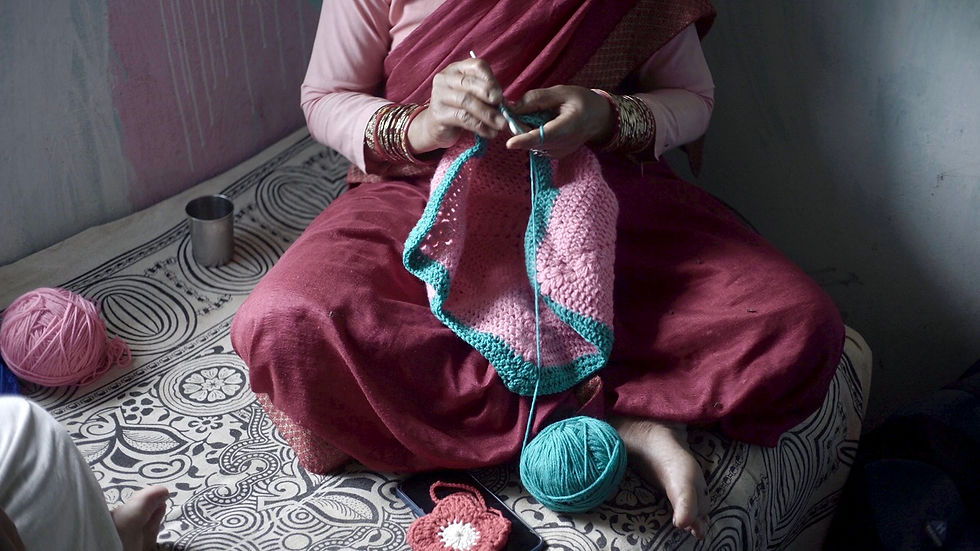
Made of Hands gave them that. Our artisans work from their homes, at their own pace, on their own terms. The work bends around their lives — not the other way around. They make crochet keychains and handmade hair accessories and soft toys and winter wear — and in doing so, they earn income from skill they have spent years developing, in a way that fits the lives they have built for themselves.
This is what we are most proud of. Not the products, though we love them. Not the customers, though we are grateful for every one of them. But this: that the women behind Made of Hands have found a way to earn from their craft, on their own terms, in the mountains where they belong.

Where We’re Going — The Future of Made of Hands
Made of Hands is not a large business. We don’t have the infrastructure of a national brand or the marketing budget of a fast fashion retailer. What we have is a clear purpose, a growing catalogue of genuinely handmade products, a team of extraordinarily skilled women, and a customer base that cares about where things come from.
That is enough to build on. And we are building.

Our ambition is not scale for its own sake — it is depth. More products that are made well. More artisans whose skill is valued and compensated fairly. More customers who choose handmade not because it is fashionable, but because they understand what it means: that someone made this, with intention, for a person they would never meet, because the making itself was worth doing well.
If you’ve found your way to this page, you’re already part of that story.
Every purchase from Made of Hands — a crochet keychain, a handmade beanie, a soft toy, a tote bag — supports a woman artisan in Uttarakhand, keeps a craft tradition alive, and adds one more object made by real hands to a world that badly needs more of them.
That’s the story behind Made of Hands.
Come be part of what happens next at madeofhands.com/shop.
Use code FIRST10 for 10% off your first order. Free shipping above ₹999.
Made of Hands — Made of love, made of hands. — Tanu Bhatt, Founder


Comments